


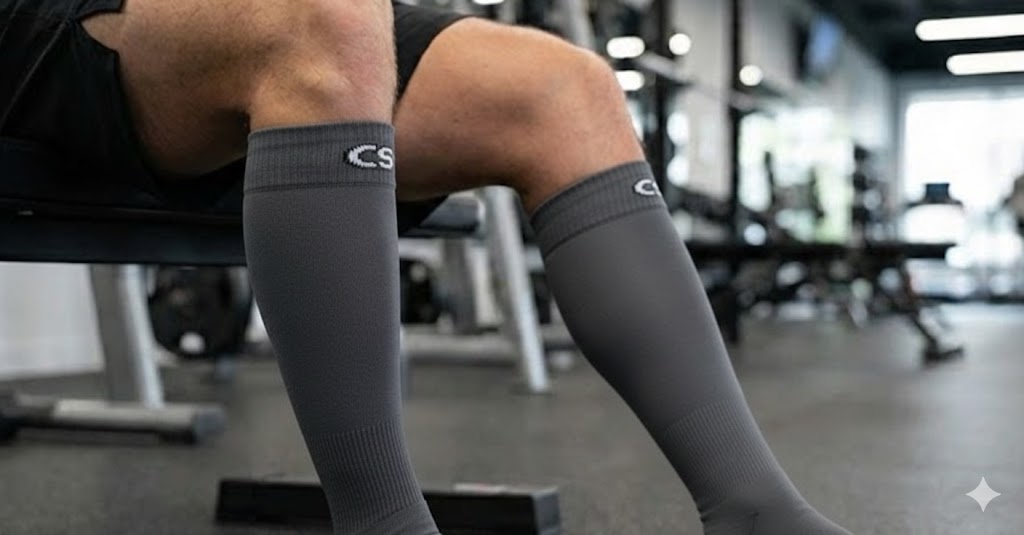
If you’ve ever finished a long day on a job site, a grueling cross-country flight, or a heavy leg day at the gym only to feel like your calves have turned into lead weights, you’ve hit the physical wall that compression socks were built to break down. For a long time, men dismissed these as "old man socks" or something you’d only see in a clinical setting. But the narrative has shifted. Today, they are a standard piece of gear for everyone from elite athletes to guys stuck behind a desk for ten hours a day.
The core of how they work is a simple mechanical trick called graduated compression. Essentially, the knit of the fabric is engineered to be tightest at the ankle and gradually gets "looser" as it climbs toward the knee.
Think of your circulatory system as a plumbing job where the pump (your heart) has to fight gravity to get fluid from the "basement" (your feet) back up to the main floor. When we sit or stand for too long, blood tends to pool in the lower legs, which causes that dull, throbbing ache and visible swelling.
By applying that specific pressure gradient, the socks manually "squeeze" the veins. This narrows the path for the blood, forcing it to move faster and more efficiently back toward the heart. It’s like putting a finger over the end of a garden hose to make the water spray further—the pressure keeps everything moving instead of letting it stagnate.


Leave a comment